
We actually ended up in Pembrokeshire as a bit of an accident, to be honest.
We were meeting friends in the Wye Valley for a few days and wanted to make it a longer trip.
Hiking and beautiful scenery were top of the list. We briefly contemplated Snowdon, but quickly decided against that when we thought about the summer holiday crowds.
We looked at Google Maps and saw an area in West Wales that doesn’t get spoken about much, so off we went to Pembrokeshire.
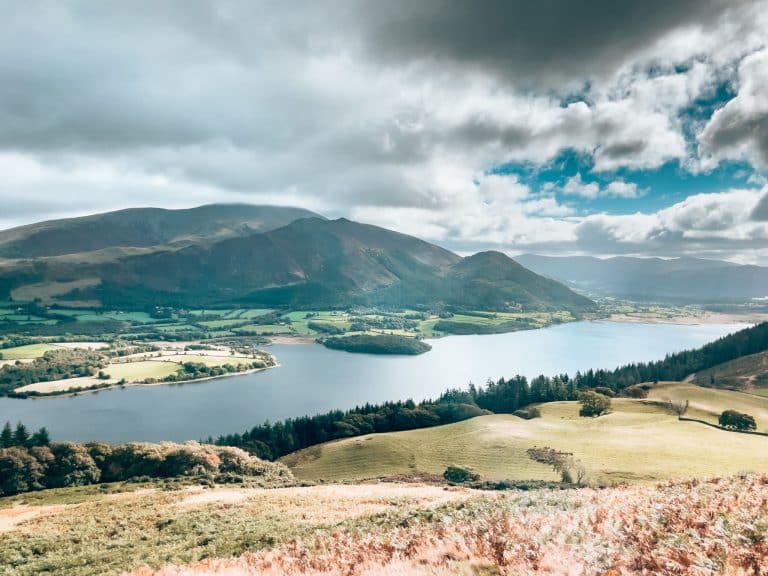
Pembrokeshire has managed to largely stay off the tourist trail. It’s often overlooked as a UK staycation, compared to Devon, Cornwall or the Lake District, which is exactly why we chose it and one of the reasons it’s worth visiting.
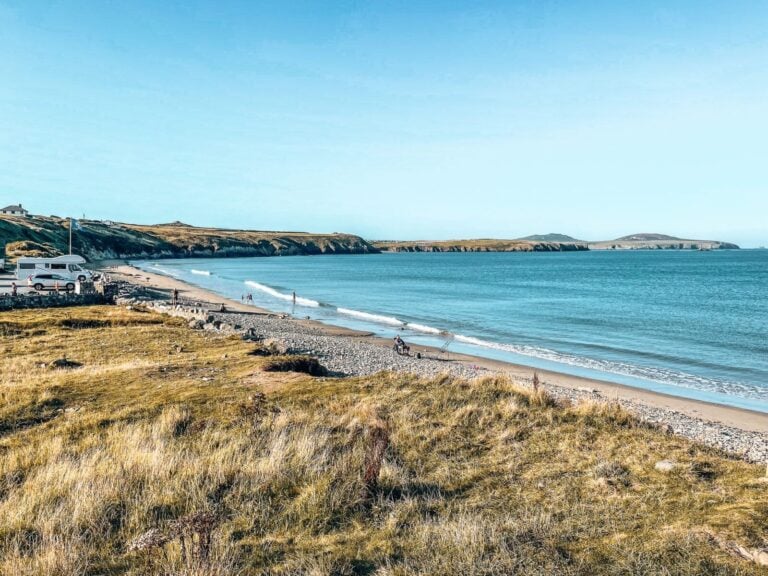
It’s quite far to get to, another reason that helps it slip under the radar. It took us 7 hours from London with a couple of stops. But it was completely worth it with the practically empty beaches, and only seeing about 5 people for the first few hours of our walk from Whitesands to Porthgain.
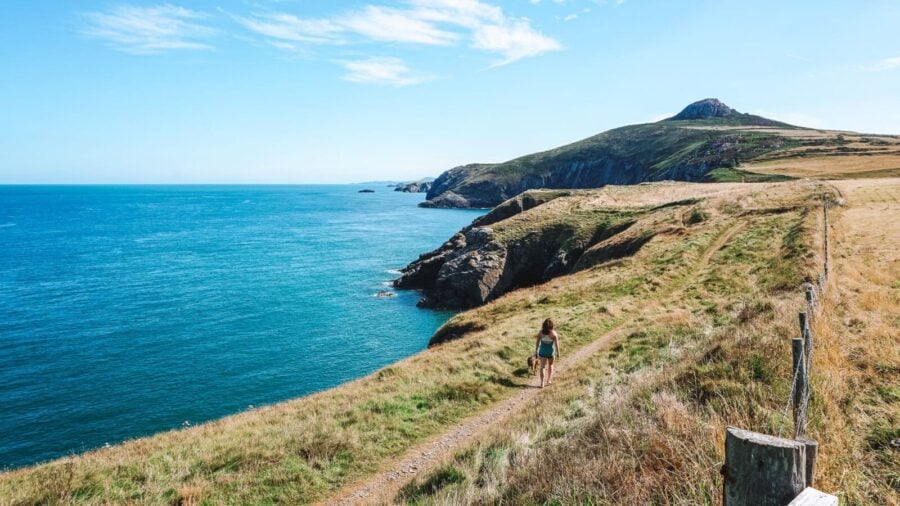
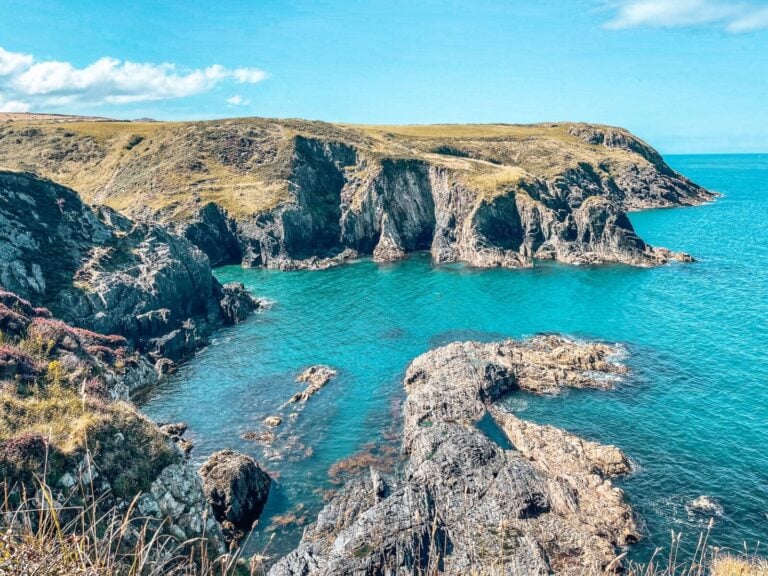
Pembrokeshire is home to some of the UK’s most incredible scenery.
Rugged coastal paths, towering limestone cliffs, a lagoon so blue it honestly looks edited (and you can swim in it), a medieval castle and huge sandy beaches you can easily find a spot on.
It’s the perfect escape from the hustle and bustle, and you really feel like you’re getting back to nature.
So, next time you’re thinking of a UK staycation, rather than hitting the tourist hotspots like Devon or Cornwall where you’ll pay through the roof for overcrowded beaches and endless traffic jams, head to this quiet corner in West Wales.
In this guide, we’ll share the best things to do in Pembrokeshire, along with everything you need to know, including the best time to visit, how long we’d recommend, the best places to stay in Pembrokeshire and how to get around.
Feel free to use the contents to jump to the section you need.
The best things to do in Pembrokeshire span the Coast Path, over 50 beaches, a striking blue lagoon you can swim in, a medieval castle and colourful towns, all within Pembrokeshire National Park.
Below is a map to help you plan your trip.
Now let’s jump into what to do in Pembrokeshire.
Opened in 1970, the Pembrokeshire Coast Path was the first national trail in Wales. It runs from Saint Dogmaels in the north to Amroth in the south for 299 kilometres. It also makes up part of the Wales Coast Path, which spans around Wales for 1400 kilometres!
Lonely Planet has described the Pembrokeshire Coast Path as one of the best long-distance trails in the world, and it’s little wonder why; it’s absolutely stunning!

Gorgeous golden sandy beaches, steep limestone cliffs plummeting into turquoise ocean, rolling red sandstone bays, volcanic headlands and flooded glacial valleys litter the landscape.

The Pembrokeshire Coast Path is located inside Pembrokeshire Coast National Park (see below), and completing the trail in one go would take between 10 and 15 days.
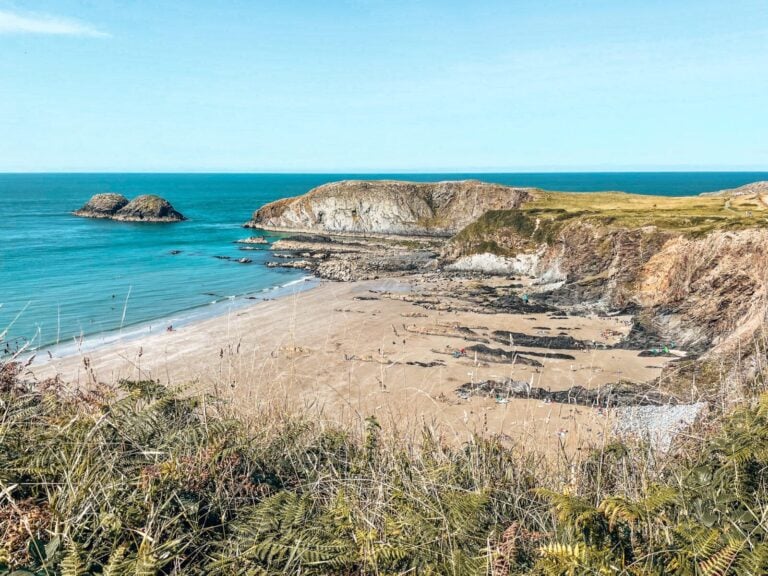
One day we hope to hike it in one go; however, on this trip we walked part of it between Whitesands and Porthgain. This trail is an adventurous, full-day 16-kilometre walk and offers some of the best scenery along the Coast Path.
If that sounds a bit much, there are also plenty of shorter walks starting at just a couple of kilometres.
For our full hiking guide, head to the link below.
The Pembrokeshire Coast National Park covers an area of roughly 629 square kilometres and has one of the most diverse landscapes in the UK. It’s also the UK’s only entirely coastal national park.
You’ll find some of the best beaches in Pembrokeshire in the national park, as there are over 50. Some are well-known and very popular with families, while others are quite hard to reach, secluded hidden coves.

As well as the beaches, another big draw to the area is to walk some of the Pembrokeshire Coast Path (see above).
Other popular outdoor activities in the park are rock climbing, coasteering, kayaking, surfing, paddleboarding, fishing and wildlife spotting.
Our top tip: coasteering, kayaking and paddleboarding can book up fast, so it’s worth sorting before you arrive to avoid missing out.

Swimming in the striking Blue Lagoon is hands-down one of the best things to do in Pembrokeshire.
The Blue Lagoon, near Abereiddy, is a former slate quarry with piercing blue-green water and is a reminder of the area’s industrial past.

Up until 1910, the quarry remained active, and the slate that was extracted from here was transported up to Porthgain by tramway and shipped out of the harbour.
Surrounded by ruins and craggy rocks, today, this area is a popular spot for kayaking, coasteering, climbing and jumping off the cliffs.
Our top tip: the water is very deep and cold, so be careful, particularly of little ones.
Pembroke Castle is one of Wales’s most impressive castles and one of the top things to see in Pembrokeshire.
It was built in 1093 by Arnulf de Montgomery, the Earl of Pembroke. Not long after, it withstood a long siege during the Norman invasion of Wales.
A century later, Charles I gave the castle to William Marshal, who became one of the most powerful men in 12th-century Britain. He rebuilt Pembroke Castle in stone, creating most of the structure you see today.

There are free daily tours and a calendar of events, so check what’s on before your visit.
Pembrokeshire food is heavily defined by its coastline and farmlands, so you can expect fresh seafood and premium meat on the menu.
After hiking the Pembrokeshire Coast Path, swimming in the Blue Lagoon, and exploring some of the best beaches in Pembrokeshire, there’s nothing better than a good meal.
Most of the pubs and restaurants will serve fresh, seasonal and local produce, so you know your money’s staying in the local area, and you’re eating the best food.
Some of our favourites are: The Farmer’s Arms for their beer garden sun trap with views of St Davids Cathedral, The Bishops for a cosy year-round atmosphere and tons of local seafood and The Sloop Inn with its maritime decor in Porthgain.
Tenby is one of the best places to visit in Pembrokeshire as it’s probably Wales’s most iconic seaside town.
It’s a beautiful little town with a maze of narrow streets, independent shops, cosy cafes, bustling alfresco dining and pastel-coloured Georgian houses overlooking the harbour.
Tenby is a great base for a few days, where you can visit wildlife parks, do boat trips from Tenby Harbour to nearby islands, walk along the Pembrokeshire Coast Path and visit several lovely beaches. There are also plenty of sea-based activities you can do, which we’d recommend booking ahead of time, as they fill up quickly.

You may think Pembrokeshire is all about the coast and beaches; however, in Stackpole there’s a National Nature Reserve home to the peaceful and lush Bosherston Lakes.
Bosherston Lakes are known for their magnificent display of water lilies and are a great place for a walk.


They’re home to a lot of wildlife, including otters, dragonflies, wildfowl, herons, wrens, tawny owls and much more.
One of the best walks is a 9-kilometre trail starting at Stackpole Quay, following the coast to Barafundle, continuing towards Stackpole Head, turning inland to Bosherston Lakes at Broadhaven Beach and looping back to Stackpole Quay Car Park.
To read our full hiking guide for this walk, head to the link below.

With 300 kilometres of unspoiled coastline, it goes without saying that one of the best things to do in Pembrokeshire is to relax on one of the many beaches.

With over 50 beaches, there’s something for everyone. Secluded coves you’ll have all to yourself, perfect for a romantic picnic; huge stretches of golden sand backed by dunes, ideal for families; or small rocky beaches excellent for rock pooling.
Some of Pembrokeshire’s best beaches include: Barafundle Bay, which involves a kilometre walk through the forest; Freshwater West, one of the best surfing spots and the award-winning wide sandy beach, Whitesands Bay.
For you Harry Potter fans, one of the best free things to do in Pembrokeshire is to visit Dobby’s grave. It’s in a beautiful spot on Freshwater West Beach, tucked behind some of the sand dunes.
Every day the memorial grows and grows with fans visiting and leaving their own contributions, such as messages on large stones or socks.

I’m well aware he’s a fictional character, but it was actually quite emotional reading all the heartfelt messages as though he was a real person. You can really tell how much he meant to people.
In St Davids, the UK’s smallest city, lies St Davids Cathedral; one of the best places to visit in Pembrokeshire for history, spirituality and art.
The site of the cathedral dates back to the 6th century when St David founded a monastery here and trained missionaries to spread Christianity to Ireland.
Over the next four centuries, the monastery was raided numerous times; however, it was a site of such religious and intellectual importance that King Alfred summoned the help of the monastic community in St Davids to rebuild it.
The cathedral you see today was constructed in 1181 and is thought to be the 4th to stand on this site. One of the first things you’ll notice as you enter the cathedral is the sloping ground and pillars due to the swampy ground it’s built on.

If you’re around on a Thursday, one of the best things to do in Pembrokeshire is browse the local market in Cross Square.
Every week, the stalls are full of locally produced crafts, art, gifts, food, drink and plants.

We didn’t know about the market before we visited, but luckily we were in St Davids on a Thursday. We bought a beautiful photograph by a local photographer of the Blue Lagoon, which now sits on our lounge wall.

That wraps up our list of what to do in Pembrokeshire; now we’ll share everything you need to know for your visit.
Yes, 100%. The scenery is incredible, from rugged coastal cliffs and sandy beaches to lush green nature reserves and colourful towns full of amazing things to do.
A car is the easiest way to get around Pembrokeshire, as this gives you complete freedom and flexibility to explore at your own pace.
If you need to rent a car, we always use Discover Cars as it compares major brands as well as small local suppliers to give you the best price.
If driving isn’t an option, you can get around Pembrokeshire using the Coastal Bus Service. However, this will take more planning, and you’ll need to be flexible as there are often only a couple of buses a day. You may also need to take multiple buses to your destination as they go via the main towns.
The bus is also good for one-way hikes in Pembrokeshire National Park. On our hike from Whitesands to Porthgain, we took the bus from St Davids to Whitesands to start the hike and back from Porthgain.
If the idea of planning routes, working out where to stay and figuring out bus timetables sounds like a lot of effort, a multi-day group tour takes care of all of that for you. Driving, accommodation and the itinerary are sorted, and Pembrokeshire is usually one stop on a wider route that takes in some of Wales’ other most beautiful areas too.
At least 3 full days, and that’s the bare minimum. We had 3 days, and we would have loved longer. You could easily spend a couple of weeks here in the summer, mixing your time between exploring the area and spending days soaking up the sun (hopefully) on the many beaches.
Late spring – early autumn, when it’s warm and hopefully sunny. School holidays will be the busiest, so if you can visit outside these times then do so.
You can absolutely visit Pembrokeshire in the winter for crisp coastal walks and to explore the towns, but some of the pubs, restaurants, cafes and seasonal activities either close or have reduced hours.
Wherever you stay in Pembrokeshire, you can explore the whole area. It’s around an hour to drive from the north to the south, so pick one place as your base rather than staying in multiple places.
A few places to stay in Pembrokeshire we’d choose are:
St Davids: this is where we stayed and would probably stay again. It’s a beautiful little city full of pubs, cafes and shops and within easy reach of beaches and coastal walks.
Tenby: great if you want something a bit livelier and easy to walk to multiple beaches rather than relying on a car or transport. There are tons of activities, boat trips to the nearby islands and direct access to the Pembrokeshire Coast Path.
Yes definitely. These Pembrokeshire attractions fill up weeks in advance, particularly during the summer, so book before you go to avoid missing out. Click on one of the activities below to go to the booking page.
We absolutely loved our time in Pembrokeshire and can’t wait to get back one day and see more of it. If you have any questions or want to know more about anything in this guide, then leave a comment, and we’ll get back to you.
If you’re looking for more UK inspiration, then check out our other guides below.
And if you want to follow along in real time – life in London, behind-the-scenes chaos, more guides and inspiration and our adorable dog Plum, then find us on Instagram.