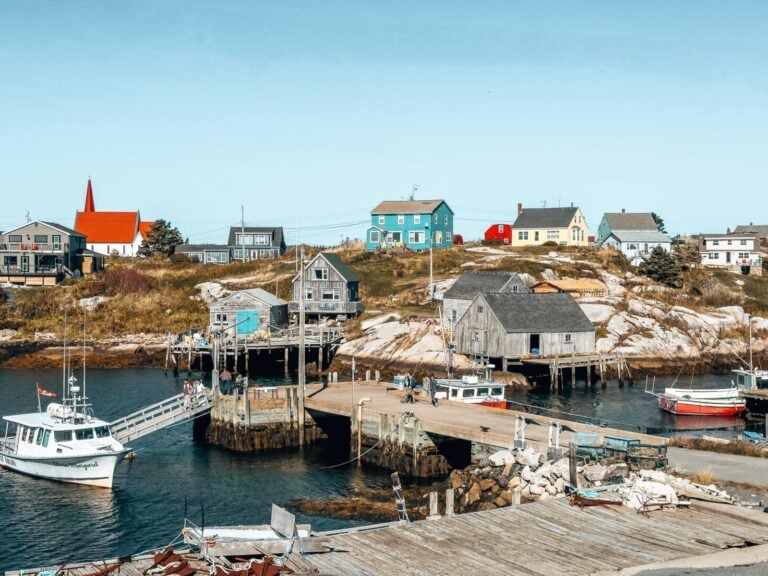

We’ve both done this Canada road trip in different ways. Andy spent a couple of months criss-crossing Canada by car, driving this stretch as part of a much longer journey from Vancouver to Toronto. I spent two weeks with my family, driving from Calgary to Vancouver the summer they came to visit when we lived in Whistler.
However you do it, this is one of the best Canada road trips you’ll ever do. Turquoise lakes that don’t look real, ancient glaciers, thundering waterfalls, and the epic Canadian Rockies stacked up on either side of the road for most of the way.
You can drive it in either direction, but give yourself two weeks if you can. 10 at a minimum. Here’s every stop worth making, starting in Calgary and finishing in Vancouver, or the other way round.

Driving from Calgary to Vancouver takes around 15 hours non-stop, but definitely don’t do it that way. This is an incredible Canada itinerary whether you’ve got 10 days or ideally a full 2 weeks.
The route takes you from Stampede City (Calgary) through the Rocky Mountains to Banff National Park, Canada’s oldest and most visited national park, along the Icefields Parkway to Jasper, into British Columbia via Clearwater, on to Whistler, and finally down the Sea to Sky Highway to finish in Vancouver, regularly voted one of the best places in the world to live.
Here’s the full route mapped out, so you can see exactly how it fits together. Below that, we’ll take you through every stop, from Calgary all the way to Vancouver, including where we stayed and other options if you want something different.
I flew from Vancouver to Calgary to meet my family, who were flying from London. I hadn’t seen them in almost a year, so I was very excited.

Calgary is the main gateway to the Canadian Rockies, and if you’re short on time, you can pick up your car and be on the road to Banff within an hour and a half of landing. If you’ve got a bit longer, though, it’s worth giving the city a day or two before heading into the mountains.
Calgary is Canada’s fifth-largest city, and famous for the Calgary Stampede every July. It’s young and cosmopolitan, helped along by both the local job market and its proximity to the mountains and everything on offer there.

We always find that one of the best ways to get your bearings in a new city is from above. Head up the Calgary Tower for 360-degree views across the city before you set off on the rest of your road trip from Calgary to Vancouver.
Beyond that, Calgary’s got plenty of quirky bars, nice cafes, breweries and tons of shopping. If you want to dig into the country’s history, the Heritage Park Historical Village, Canada’s largest living museum, is worth a stop too.
Want to see all of this without worrying about routes or logistics? A full-day guided tour covers the Calgary Tower, Heritage Park, the Zoo and Peace Bridge, with a driver and local guide sorting the rest. Just note, entry tickets for the attractions themselves aren’t included, so it’s worth booking those separately in advance.
Banff is the first stop on your Calgary to Vancouver trip, about an hour and a half from Calgary on the Trans-Canada Highway 1.
It’s the most famous town in Alberta, and it’s easy to see why. Turquoise lakes, pristine wilderness and mountain scenery literally everywhere. This is the Canadian Rockies at their most iconic and one of the best places to visit in Canada if you’ve only got time for one mountain town.
Banff Avenue is the main road running through town, with dramatic mountains as a backdrop the whole way.
You’ll find bars, restaurants, ice cream parlours, local cafes, museums and shops here. There’s even one that sells Christmas decorations all year round.
Banff is the only town inside Banff National Park, so it gets busy. If you’d rather escape the crowds, Sunshine Village is a good alternative to stay instead. It’s still busy, but nowhere near the level of Banff.
Give yourself 2-3 days minimum to properly make the most of your time here. Our favourite places to visit in Banff are:

Banff’s smallest peak, and it’s right in town, only an hour to the top. From the summit, you get amazing views over Banff, the Bow and Spray River Valleys, and the mountains surrounding them.

A path running alongside the Bow River, good for a picnic or a bike ride. There are plenty of benches and scenic viewpoints over the Bow Valley and the peaks around it. If you’re lucky, you might spot deer or elk along the way.

The best views over Banff and Bow Valley are from the top of Sulphur Mountain.
Take the gondola up for an easy, scenic ride, or if you’d rather not pay for it, hike the 5.5km of steep switchbacks instead. Either way, you’ll forget all about your legs once you see the view.

This was one of my favourite spots in Banff. They’re a series of lakes and lush marshland in the Bow River Valley, with views of Sulphur Mountain and Mount Rundle. You may see elk, moose and bears.
There are hiking trails around the lakes, or rent a canoe and paddle across instead.
Our top tip: rent a bike from town and cycle the Bow River Trail to reach the lakes.

A short drive from Banff is the 22km-long glacial Lake Minnewanka. The First Nations Stoney people named it “Minn-Waki”, meaning “Lake of the Spirits”, as they believed spirits lived in the water.
Giant peaks surround the lake, and you’ll want to stop for a photo every few steps. There are hiking trails here too, but keep bears in mind. Between July and September, you’re required to hike in a group of at least four and carry bear spray. This isn’t recommended; it’s a requirement, and you can be fined heavily if you don’t follow these rules.
If you’re not a group of 4, you can wait at the entrance and ask people if you can hike with them. Chances are, there’ll be other people not in a group of 4 who turn up wanting to do this.
If hiking’s not for you, you can take a cruise on the lake instead, or even go scuba diving, believe it or not.

Just to be confusing, Lake Louise is the name of both a little town and the world-famous lake.
There’s not much to the town; the real draw is Moraine Lake and Lake Louise, two of the most photographed spots in the Canadian Rockies.
Our top tip: stay a night, if not two, in Lake Louise rather than driving from Banff. We did the lakes in a day from Banff, which is possible, but they get extremely busy. Staying close by means you can see them first thing before the day-trippers arrive, or again in the evening once they’ve gone.
I made my family get up at 5am to leave Banff, which they weren’t exactly thrilled about, until we got to Moraine Lake at 6:30am and found the car park already half full.
I’ll start with Moraine Lake, as this was my favourite of the two.
It’s honestly one of the most beautiful places in the world, the iconic lake you’ve probably seen on all the postcards. It even used to be on the back of the Canadian $20 bill.

Access here has changed since we visited, so pay attention to this bit. Moraine Lake Road is now closed to personal vehicles year-round; you can’t drive and park there anymore.
To get there, you’ll need to book a Parks Canada shuttle, join a licensed tour, or be a registered guest at Moraine Lake Lodge, which is the only way to drive in yourself. Shuttles run from June to mid-October and need to be booked as far in advance as possible, as they sell out.
If you’d like to go for sunrise (which we’d 100% recommend), the easiest way to do it is on a dedicated sunrise tour. You’ll be picked up from your hotel in Banff, Canmore or Lake Louise while it’s still dark, arrive at Moraine Lake before the crowds, then head to Lake Louise for Golden Hour.
Watching the sun come up and the lake change colour is honestly something else. I stood there gazing out over the water, framed by the Valley of the Ten Peaks, and just didn’t want to leave.
The brilliant blue-green colour comes from light refracting off fine rock particles carried into the lake by the glacier, and the intensity actually shifts through the summer as the glacier melts.
There are a few hikes in the area, ranging from easy to challenging. We did the short walk to Consolation Lakes, a fairly flat 6km round trip through the forest.
Lake Louise is one of the most famous lakes in the world, and yes, it’s become one of the busiest places to visit in Canada in summer, but it genuinely can’t be missed.
The aqua-green water, rugged snow-capped mountains and Victoria Glacier behind it make this one of the best places to visit in Canada, full stop.

Parking here has got trickier too, so it takes a bit of planning.
The Lakeshore car park fills by sunrise most days between May and October, and paid parking is now in effect on top of your park entry pass. Honestly, we wouldn’t recommend driving here during those months at all. Take one of the shuttles, or walk in via the trail system if you’re staying in Lake Louise.
Arrive early morning or late afternoon, once the tour buses have gone, and it’s a completely different, far more tranquil place. Or, rent a canoe and paddle out, away from the crowds.
If you really want the lake to yourself, staying at the Fairmont Chateau Lake Louise is the way to do it properly. It sits right on the shore, so you can be down by the water within minutes of waking up, before the day-trippers arrive and before anyone else staying in the town has even had breakfast.

Same again in the evening, once the buses have gone and everyone else has headed back to Banff or Lake Louise Village, you’ve still got the lake right outside. It’s a gorgeous, luxurious stay too and worth building a night or two of your trip around.
There are several hiking trails around the lake. The most popular is the Lake Louise Lakeshore Trail, running alongside the water to the other side for views back towards the Fairmont Chateau. There’s also the Lake Agnes Tea House hike, a 7.5km uphill walk that ends, appropriately, with a cup of tea and a slice of banana bread.

Rated as one of the top drives in the world by Condé Nast Traveller, the Icefields Parkway is a 232km route linking Lake Louise and Jasper through Banff and Jasper National Parks.
This is an absolute must-do on your Calgary to Vancouver road trip, and one of the best stretches of any Canadian Rockies trip you could do. Don’t rush it; give yourself at least a day to actually experience the drive rather than just getting through it.
One thing worth knowing before you set off: there’s no cell service anywhere along the parkway, so download offline maps and let anyone you need to know your plans know before you leave Lake Louise or Jasper.
The Parkway takes in soaring mountain peaks, glacial lakes in colours that don’t look real, cascading waterfalls and over a hundred glaciers.

You won’t want to put your camera down, and you might even spot a grizzly bear on the roadside if you’re lucky.
Here are some of the main stops.
39km from Lake Louise is Bow Lake, the start of the Bow River that runs through Calgary to Hudson Bay.
It’s your first main stop from Lake Louise, and here you can see Crowfoot Glacier, Bow Glacier, Wapta Icefield, Crowfoot Mountain and Mount Thompson.

45.5km from Lake Louise. You’ll have almost certainly seen pictures of this lake before.
Peyto Lake is a striking blue glacial lake, and the colour genuinely doesn’t look real until you’re seeing it for yourself.
The viewpoint is only a 15-minute walk from the car park, so if hiking’s not your thing, this is a view you don’t have to work hard for.
If you’ve got a bit more time and energy, keep going past the main viewpoint up to Bow Summit, the highest point on the Icefields Parkway. It’s a short but steady climb, and it gets you a higher, quieter view over both Peyto Lake and Bow Lake, away from the crowds at the main lookout.

80km from Lake Louise, a significant spot where three rivers meet: the North Saskatchewan, the House and the Mistaya.
Our Top Tip: this is the only place on the whole Parkway to get fuel, and it’s noticeably more expensive than Jasper or Lake Louise, so it’s worth filling up before you set off, whichever direction you’re driving.
Not far past Saskatchewan River Crossing, keep an eye out on the cliff face at Cirrus Mountain for dozens of thin waterfalls trickling down the rock, giving it its name. You can see it clearly from the car, no detour needed, though there’s a small pull-off if you want to stop for a proper look.
130km from Lake Louise. These icefields straddle Banff and Jasper National Parks, covering 325km² at 100-365 metres deep, making them the largest icefields south of the Arctic Circle!

You can take it in from the Columbia Icefield Discovery Centre, or book a trip on an Ice Explorer out onto Athabasca Glacier itself.
The Discovery Centre also has a museum, with a large 3D model of the Columbia Icefield and displays on alpine wildlife and how glaciers form, grow and retreat.
There are several ways you can experience the Columbia Icefield below: the Skywalk on its own for the view, or the tours that also get you out onto the glacier, one with Peyto Lake included, and one with lunch.
179km from Lake Louise. A lovely spot for a picnic, Sunwapta Falls is a powerful 18-metre waterfall with a dramatic mountain backdrop.
The falls are especially impressive late spring-early summer when the snow is melting. There’s a 1km trail out to the lower falls if you want to stretch your legs.
The Sunwapta River is home to one of Jasper’s best whitewater rafting runs, through the Endless Chain Mountain Range, fed all the way from the Athabasca Glacier. You’ll spend around 1.5 hours on the water, surrounded by more incredible Rockies scenery but from a very different angle and view than in the car. No experience needed.

202km from Lake Louise. The Athabasca River roars into a narrow canyon here, and it’s not the height that gets you; it’s the sheer volume and power of the water.
There are several viewing platforms around the falls, each giving you a different angle.

The next stop on your Calgary to Vancouver road trip is Jasper. This alpine town is the service centre for Jasper National Park, the largest park in the Canadian Rockies and a UNESCO World Heritage Site.
The town is full of restaurants, shops, bars and hotels. Fewer people visit Jasper as it’s further from a major airport hub, so it’s quieter and more relaxed than Banff or Whistler.
Nestled amongst the snow-capped Rockies, the park is home to glacier-fed lakes, abundant wildlife, over 1,000km of hiking trails, the Athabasca Glacier and the highest mountain in Alberta, Mount Columbia. Jasper is also the world’s second-largest Dark Sky Preserve, so if you’re here on a clear night, it’s genuinely worth stepping outside town and looking up.
We had two nights in Jasper, which was a good amount of time to see the highlights. If time allows, you could easily stretch that to three or four. Some of the best things to do in Jasper are:
A quick note before this one: Maligne Canyon is currently closed for the 2026 season following the damage from the 2024 wildfire. It’s still undergoing geotechnical assessment with no reopening date confirmed yet. Worth checking the official status before you go in case that’s changed by the time you’re planning your trip.
When it’s open, it’s the deepest and one of the most spectacular canyons in the Canadian Rockies. A 50-metre-deep gorge with waterfalls thundering through it, and a fairly easy hike crossing six bridges, 3.7km each way.

For one of the best views in the Canadian Rockies, take a ride up Whistlers Mountain on the Jasper SkyTram, with the town of Jasper laid out far below and mountain views on every side.
As you ride up, the guide talks you through the history and geology of what you’re looking at. At the top, there’s a souvenir shop and restaurant if you fancy a bite before heading back down.

Maligne Lake is the second-largest glacial-fed lake in the world. The valley is genuinely stunning, and even in the summer, the lake is surrounded by snow-capped mountains. Spirit Island, sitting in the middle of the lake, is one of the most photographed scenes in the world.
The best way to take it all in is on a lake cruise. Keep your eyes peeled for the wildlife that calls this area home: mountain goats, bighorn sheep, bears, wolverines and elk.

These two lakes are the most accessible from Jasper, only 6km from town.
Surrounded by snow-capped mountains, they offer quiet beaches, picnic spots, hiking trails and frequent wildlife sightings. Rent a canoe or rowboat and paddle out; it’s one of the best spots in Jasper for it.
Our Top Tip: if you’d rather stay on a private beach with direct access to Pyramid Lake where you can fish, canoe and hike straight from your room, check out Pyramid Lake Lodge.

Clearwater is great for a night to break up the journey between Jasper and Whistler. Driving it in one go would take around nine hours, so to save us from a tiring day, we split the distance over two days.
Clearwater is the gateway to Wells Gray Provincial Park, sometimes called “Canada’s Waterfall Park” for good reason. It’s home to 41 named waterfalls across 5,250km² of wilderness, alongside abundant wildlife, lush forests, alpine meadows and glacier-fed lakes.
Worth knowing before you go: the road is paved as far as Helmcken Falls, but the last stretch out to Clearwater Lake turns to gravel. Most rental car companies restrict driving on unpaved roads, so check your rental agreement first. Bring bug spray too; the mosquitoes here are relentless in summer.
The park’s main event. Plummeting 141 metres into the canyon below, Helmcken Falls is the fourth-highest waterfall in Canada. It’s just a short walk from the car park to the viewing platform, which is wheelchair accessible too.

The first waterfall you’ll reach driving in from Clearwater, just 10 minutes up the road. A short walk gets you to the viewpoint over a dramatic 75-metre drop into the gorge below.
Nicknamed “Mini Niagara”, Dawson Falls cascades 90 metres wide across ancient lava beds. Another easy 10-minute walk through old-growth forest.

This one’s a bit more effort but worth it if you have time. It’s a 3km walk each way, around 2 hours round trip. You can also walk behind the waterfall and even go for a swim in the plunge pool at the bottom.
If you’ve got the time, Clearwater Lake is worth paddling; it’s one of the largest paddle-only lakes in North America, so no motorboats are disturbing the peace. Rent a canoe or kayak and get out on the water for a proper break from driving.
If you fancy getting out on the water yourself rather than just admiring it from the falls, the Clearwater River is one of the best whitewater rafting spots in British Columbia, and there are a few different ways to do it. Choose from a half-day trip through some of the river’s biggest rapids, a similar half-day option that stops at a waterfall for a swim and an optional cliff jump, or the full-day option with a waterfall hike and lunch on the water.
Our penultimate stop on the Calgary to Vancouver road trip was Whistler, where I was living at the time. I couldn’t wait to show the family what this little mountain town I’d fallen in love with had to offer.

We broke up the journey with a stop at Joffre Lakes, about an hour north of Whistler, a hike that rewards you with three striking blue glacial lakes. If you’ve got the time to stop, definitely do.

Most people picture Whistler as a winter playground with world-class skiing and snowboarding. While that’s true, it has just as much going on in summer, and honestly, I ended up preferring it.
Here are some of the best things to do in Whistler.
An absolute must-do.
The Peak 2 Peak Gondola holds the Guinness World Record for the highest cable car above ground in the world, connecting Whistler and Blackcomb Mountains, a 4.4km, 11-minute ride with snow-capped mountains, glaciers, alpine lakes and forest below you.

Our Top Tip: wait for one of the black gondolas, as these have glass bottoms.
There are restaurants up here too, with decks looking straight out over the mountains and down into Whistler Village.
Your Peak 2 Peak pass also gets you onto the alpine hiking trails on Whistler and Blackcomb Mountains.
Whether you want a short, flat family walk, or something more challenging, to lakes, alpine meadows and glaciers, there’s something for every pace here. Keep an eye out for marmots too; their whistle is where the town’s name is said to come from.

The most scenic lake that’s easily accessible from Whistler.
There are a few different parks around it where you can swim, rent kayaks or paddleboards, or just relax on the grass. Check out our full Whistler in summer guide for the other lakes around town too.

Our Top Tip: rent a bike from town and cycle the Whistler Valley Trail to reach the lakes.
Whistler is known for this. Mountain biking is the most popular summer sport here, with more than 80km of trails drawing riders from all over the world.
Ziplining is a great way to see more of the mountain scenery, with tours for every age and level that whizz you along lines on Whistler and Blackcomb Mountains. For the biggest one, the Sasquatch takes you soaring under the Peak 2 Peak Gondola.
Ziplining is one of Whistler’s most popular activities in summer, so it’s worth booking ahead before it sells out. Take your pick below.
The Whistler Sliding Centre, built for the 2010 Olympics, runs public Summer Bobsleigh from mid-June to mid-September, Wednesday to Sunday, so it’s worth checking dates if you’re passing through outside that window.
You can also bungee jump over the Cheakamus River.
There’s plenty more Whistler has to offer; our full guide to Whistler in summer covers everything else, including where to eat and drink too.
The short drive between Whistler and Vancouver has earned its own section, as there are some great points to break up the journey.
Driving it in one go should take about an hour and a half, but I’d recommend giving it a half day to do it properly.
10km south of Whistler, you’ll find seven abandoned freight cars from a 1956 derailment, left to be reclaimed by the forest ever since. It’s a favourite among graffiti artists, so you’ll find some pretty cool artwork on them.

17km south of Whistler, Brandywine Falls Provincial Park has a 70-metre waterfall well worth a photo stop. The viewpoint is only a 10-minute walk from the car park, so it won’t eat up much of your day.

Just south of Squamish, Shannon Falls is BC’s third-highest waterfall at 335 metres, and you can’t miss it from the highway. A short, easy trail through old-growth forest gets you to the viewing platform, worth the five-minute detour even if you’re not planning to linger.

60km south of Whistler, in the old logging town of Squamish, is the granite monolith Stawamus Chief, often cited as the second-largest granite monolith in the world.
It’s a great spot to stretch your legs if you’re up for a hike, rewarding you with panoramic views over Howe Sound and the Coast Mountains.

Right next to the Stawamus Chief and Shannon Falls, if you’d rather skip the climb but still want the views, the Sea to Sky Gondola gets you there without the legwork.
The final stop on your Calgary to Vancouver road trip. Vancouver has been voted one of the top places in the world to live, and it’s easy to see why.
The city has it all. Beaches, mountains and city life all in one place. I’d recommend a couple of days here.

Stanley Park is huge, so if you want to actually make a dent in it, rent a bike.
Explore the 400-hectare park for views of the sea, the harbour, the mountains and the city skyline, with trails leading to beaches, wildlife, historical landmarks and Canada’s largest aquarium.
Don’t miss the First Nations Totem Poles either, one of the park’s most photographed spots.

Take the Skyride, North America’s largest aerial tramway, or hike up the Grouse Grind if you’re feeling energetic, for panoramic views across the city, the Pacific Ocean and surrounding mountains.
It’s a huge outdoor playground up here with ziplines, hiking trails, disc golf and paragliding to name a few activities. If you haven’t seen any bears yet, there are two orphaned grizzlies living at the top of Grouse: Grinder and Coola.

The Capilano Suspension Bridge offers a truly BC experience. It’s a Vancouver landmark spanning 137 metres and sits 80 metres above the Capilano River. Meander through the cedar-scented rainforest on suspended footbridges, stairs, platforms and the Cliffwalk.
You’ll also find the world’s largest private collection of totem poles.

Tucked under the Granville Street Bridge, this is one of the best spots in the city for food, shopping, and just wandering. The public market alone is worth the trip with fresh produce, seafood, local crafts and enough food stalls you’ll struggle to decide what to have for lunch. It’s easy to combine with a walk along False Creek or a short hop over on the little Aquabus ferries.
In the evening, check out Gastown for its trendy food and drink scene. Known for its whistling Steam Clock, this is Vancouver’s oldest neighbourhood and retains its historic charm.
Stroll along Water Street for old buildings, cobbled streets and vintage lampposts, then finish the day in one of the city’s best restaurants, wine bars, or a chic cocktail bar.
As much as I enjoyed Vancouver, most of the city felt like it was missing character. Very modern and polished, nothing like the old European cities I love. Gastown, however, is the exception. Victorian-style architecture, red-brick buildings and cobbled streets, a real contrast to everywhere else in the city.
If you’d rather see the city with someone else doing the planning, this tour covers Stanley Park, Gastown and Granville Island along with Robson Street, English Bay, Yaletown and Chinatown. It also includes a boat cruise on the water and a trip up the mountain for the view from above, with lunch included too.

Planning a road trip in Canada for the first time? Here’s everything you need to sort before you go.
May to September, with July onwards if you want less snow on the higher trails, though you’ll still find some at elevation even in August.
July and August are the busiest months because of the summer holidays. If you have flexibility, travelling outside of the school holidays is worth doing.
September is a great time to hike as the weather’s cooler, and most of the snow will have melted.
A car gives you the most freedom and is by far the easiest way to do this route. No fixed schedule, no waiting on anyone else, and you can stop wherever catches your eye. It also means you can arrive at the most popular places like Lake Louise and Moraine Lake before the tour groups, when it’ll be quieter.
It’s not the only option, though. Guided tours are great and range from single-day to multi-day itineraries, group tours or private tours and cover everything from Banff and the Icefields Parkway through to Whistler and Vancouver.
If you’d rather sit back and let someone else handle the logistics, or want your own private guide rather than joining a group, that’s possible here too.
If you do decide to drive, book well in advance regardless. The towns along this route are small, and in peak season you won’t find a single room or campsite left.
Yes, since you’re not driving in a loop. You’ll pick up in Calgary and drop off in Vancouver (or vice versa), which usually comes with a one-way drop-off fee on top of the standard rental cost.
Prices vary a lot between companies, so it’s worth comparing a few rather than booking the first one you find. Booking early also tends to get you a better rate.
Yes, the Canada Strong Pass is required to enter Banff and Jasper National Parks. It’s free for this summer and can be purchased here.
UK passport holders need an Electronic Travel Authorisation (ETA) to enter Canada. It’s $7 and valid for 5 years (or when the passport expires, whichever comes first). For any other passports, check your entry regulations online before you travel.
Canadian dollars. At the time of writing, 1 CAD is roughly 0.72 USD. Always worth checking the current rate closer to your trip, as it changes.
Types A and B, the same as the US, with two flat parallel pins plus a grounding pin. You’ll likely need a voltage converter too, as Canada runs on 120V, while the UK and Europe run between 220V and 240V. Ask Helen how she knows this one; she caused a power cut plugging in her GHDs without one, and they never worked again!
Two weeks, ten days, or somewhere in between, however you do this drive, it’s one of the best road trips in the world. Turquoise lakes, glaciers, waterfalls you’ll lose count of, and the Canadian Rockies stacked up on either side of the road the whole way through.
If you have any questions or just want to say hi, then drop us a comment, and we’ll get back to you.
Looking for more Canada inspiration? Check out our other Canada guides below for everything you need.
And come find us on Instagram for real-time updates, behind-the-scenes chaos and more travel tips and inspiration 😊


2 Comments
Hi , how long did the road trip take you?
Hey – we’d recommend 2 weeks for this road trip though it can be done with 10 days 🙂