
Western Canada is scattered with postcard-perfect lakes. Whether you’re planning a full road trip between Calgary and Vancouver, or you just want to know which ones to prioritise on a shorter trip, working out which are actually worth the stop isn’t easy from a screen.
We lived in Whistler in Western Canada for a few years, and between road trips, hikes and weekend camping trips, we’ve stood in front of every lake on this list ourselves. A few, like Garibaldi Lake and Joffre Lakes, are worth a full trip on their own; we’ve written dedicated guides to both. Most of the others are easy stops you can build straight into your route.

Below, we’ve rounded up our 11 favourites and also included a link to hotels in the nearest town.
Here’s where each of these 11 lakes sits. Useful for seeing how they line up if you’re planning a road trip, or which ones cluster together if you’re short on time and can only fit in a few.
Western Canada is home to some of the most beautiful lakes in Canada; glacier-fed and turquoise-blue, mostly found throughout the Canadian Rockies in Alberta and British Columbia.
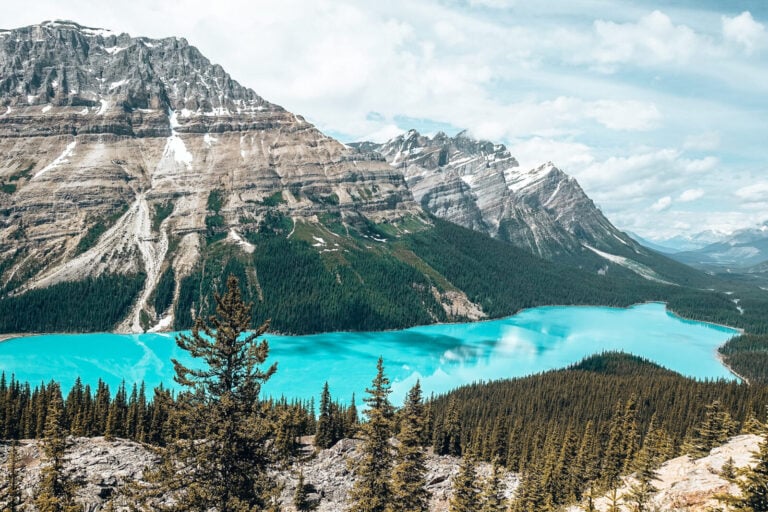
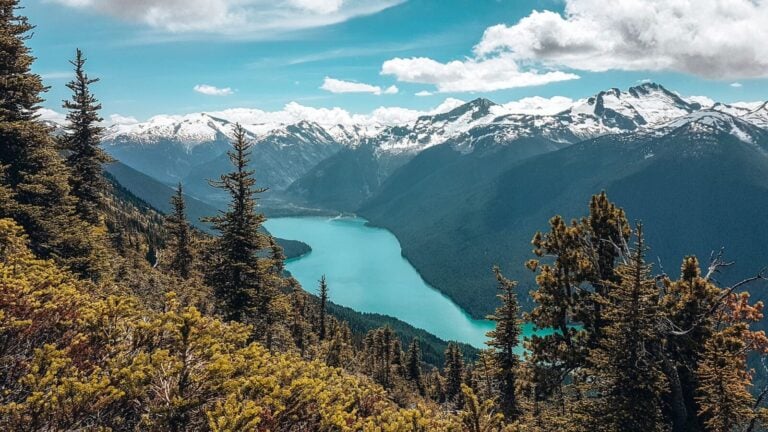
Moraine Lake, Lake Louise and Peyto Lake are among the most famous lakes in Canada. Garibaldi Lake and Cheakamus Lake are just as striking, and among the most famous lakes in BC, though they see fewer crowds.
None of the lakes below are actually Canada’s biggest by surface area. The country’s largest sit further north and east, with Great Bear Lake and Great Slave Lake among them. But for postcard-perfect beauty, these are the ones worth planning your trip around.
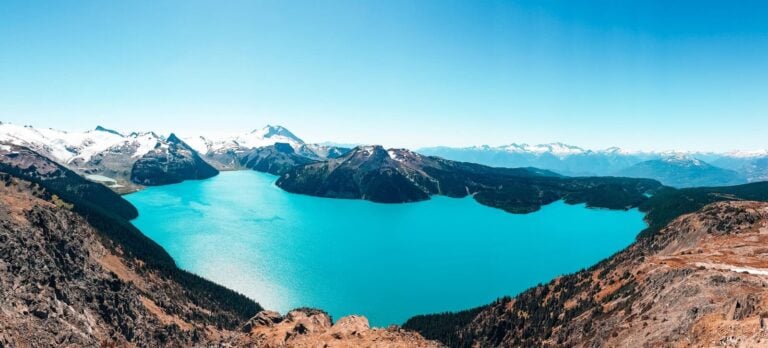
If we had to pick just one, it’d be Garibaldi Lake. It’s our absolute favourite on this list, and part of that is the effort it takes to get there. It’s an 18km round-trip hike rather than a car park view. That distance means fewer crowds and completely unspoiled scenery. Snow-capped mountains on one side, Sphinx Glacier as the backdrop, and a lake so blue it honestly doesn’t look real.
Right, onto the list. Here are our 11 picks, starting with the one that needs no introduction.
We’re going to kick off our guide with this absolute treasure in Banff National Park.
Framed in the Valley of the Ten Peaks, Moraine Lake is hands down one of the most spectacular lakes in Western Canada.
No Canadian road trip would be complete without a visit. Not only is it featured on pretty much every postcard you’ll see, but it also used to be on the $20 bill.
The whole area is unreal. The intensity of the blue colour even changes throughout the summer as the glacier melts into the lake.
You can do a few hikes in the area to take in the view from different angles.

Moraine Lake Road is closed to personal vehicles year-round, so you’ll need to book a Parks Canada shuttle or a guided tour to get there. Several run early enough to still catch sunrise.
Moraine Lake Lodge is the only place to stay right on the water, and the only way left to drive your own car up to the lake. Guests get canoe access included and can walk straight out the door for sunrise while everyone else queues for a shuttle.
Moraine Lake can be visited from Banff as a day trip combined with Lake Louise. Or stay in Lake Louise Village so you’re close to both.
Garibaldi Lake is our absolute favourite lake in Western Canada.
This one isn’t accessible by car and takes a bit of effort to reach. That also means unspoiled scenery and fewer crowds than some of the other lakes on this list (though it can still get busy in the summer).
Garibaldi Lake is located in Garibaldi Provincial Park, close to Whistler. It’s an 18-kilometre round-trip hike, so you’ll need a full day, but it’s completely worth it.

Nestled between snow-capped mountains and a spectacular backdrop of Sphinx Glacier is one of the most spectacular scenes in British Columbia.
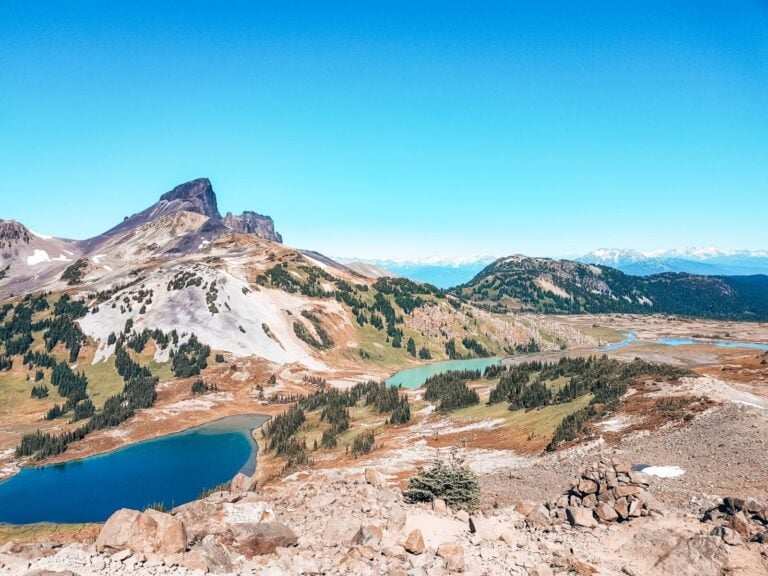
If you have the time and camping gear, we’d recommend spending a night by the lake and doing some of the other hikes in the area; just book your backcountry reservation in advance. We also hiked Black Tusk and Panorama Ridge when we spent a weekend here.

We’ve got a dedicated guide to hiking in Garibaldi Provincial Park. It covers day hikes to Garibaldi Lake, Black Tusk and Panorama Ridge individually, as well as the full 2-day route we did, camping overnight at Garibaldi Lake and taking on all 3 in one trip. Permits, difficulty ratings, distances and everything else you need are in there too.

Around the lake are several hiking trails of varying difficulty. The most popular is the Lake Louise Lakeshore Trail, running alongside the lake for views back to the world-renowned Fairmont Chateau. For a cup of tea and a slice of banana bread, a 7.5-kilometre uphill hike takes you to the Lake Agnes Tea House.
The Fairmont Chateau Lake Louise sits right on the shore, so you can be down by the water within minutes of waking up, before the day-trippers arrive. Same again in the evening, once the tour buses have gone and everyone else has headed back to town.

Our Top Tip: Lake Louise has become a major tourist hotspot, but it’s not to be missed. Stay in Lake Louise Village and arrive early morning or late afternoon when the tour buses aren’t there.

It’s probably the easiest lake to visit on this list. It’s a stop on the famous Icefield Parkway between Jasper and Lake Louise. The viewpoint is only a 15-minute walk from the car park.
Joffre Lakes are a series of 3 lakes in Western Canada known for their striking blue colour.
It’s one of the most popular hikes in British Columbia, and it’s not hard to see why. That popularity does mean it gets busy, so go in with that expectation, or aim for an early start.
The powerful turquoise comes from glacial silt suspended in the water, reflecting sunlight.

We’d recommend hiking to all three lakes. However, if you’re short on time, Lower Joffre Lake is a 5-minute walk from the car park and is stunning on its own.
Middle Joffre Lake is approximately 1 hour further up, and Upper Joffre Lake is another 15 minutes.
There’s a campsite at Upper Joffre Lake, well worth spending a night at. You can also hike up to Matier Glacier and see all 3 Joffre Lakes lined up.
For the complete guide, read our dedicated post on hiking and camping at Joffre Lakes.

Known for its azure waters and a backdrop of jagged glacier-topped peaks, Maligne Lake is nothing short of spectacular.

The best way to explore is on a cruise. Keep your eyes peeled for bighorn sheep, bears, wolverines, elk and mountain goats.

A short drive from Banff is the 21-kilometre-long glacial Lake Minnewanka. The First Nations Stoney people named it “Minn-Waki”, meaning “Lake of the Spirits”, after a belief that spirits lived in the water.
Surrounded by towering peaks, it’s a hotspot for recreation, some of which may surprise you.
Hikes range from easy shoreline strolls through aspen trees to challenging climbs with panoramic views across the lake. There are also a few biking trails at certain times of the year.

To really see it up close, hop on a boat cruise or rent a canoe or kayak. You can even explore underwater ruins, an old dam, a bridge and a resort submerged when the lake was raised.
Lake Minnewanka is also a great place just to relax by the water and soak up the views. There are also a few picnic spots, a cooking shelter and a cafe.
Another stop on the Icefields Parkway, and probably one of the most overlooked lakes in Western Canada, given how small it is. Most people stop for a quick photo before continuing to Lake Louise or Peyto Lake.
Nestled in the heart of the Canadian Rockies and fed by meltwater from Bow Glacier in the Wapta Icefield, it’s got some striking mountain backdrops. On a clear, calm day, the water mirrors the surrounding peaks perfectly.

There’s an easy shoreline trail with views of Crowfoot Mountain, flanked by Crowfoot Glacier looming above.

The walk passes through ancient cedar forest, the whole area filled with a distinct scent. Once you reach the lake, you’re rewarded with more of that remarkable blue, surrounded on all sides by huge mountains and lush wilderness.
We’re finishing this list off with Rainbow Lake, one of Whistler’s most pristine alpine lakes. Again, it’s a hike to reach, but easily accessible from the village.
This was one of our favourite hikes while living in Whistler. It’s mostly forest, with fairytale creek bridges and feels a bit like the Enchanted Forest.

Once you reach Rainbow Lake, follow the path to the other side for a slightly higher vantage point. From here, you get views of Rainbow Lake and Wedge Mountain looming in the distance.
The hike is rated as intermediate and will take around 6 hours for the 16km return trip.
Our Top Tip: Rainbow Lake is a source of drinking water for Whistler Village, so camping and swimming are prohibited.
Well, there you have it, our favourite lakes in Western Canada. We hope we’ve inspired you to visit some of these on your own trip. Maybe even spend a night camping in Garibaldi Provincial Park or Joffre Lakes Provincial Park.
Always make sure you’re well-prepared in the mountains. The weather can change fast, so take layers, wear proper hiking shoes, and always tell someone where you’re going. If you’re hiking more remotely, also carry bear spray with you.
Have you been to any of these lakes, or are you planning a trip? Let us know in the comments.
Check out our other Canada guides below for more inspiration.
And find us on Instagram for real-time updates, behind-the-scenes chaos and more travel tips and inspiration 😊