
Most people hike Panorama Ridge in one long, 30-kilometre day. I did that with my brother a few weeks before this trip with Andy, and while it’s definitely doable, splitting it over 2 days, adding in Black Tusk and camping at Garibaldi Lake along the way is what we’d recommend. You’ll see much more of the spectacular scenery and spend more time taking it all in rather than rushing.
We hiked to Garibaldi Lake and Black Tusk on day 1, camped at Garibaldi Lake Campground, then tackled Panorama Ridge fresh the next morning.
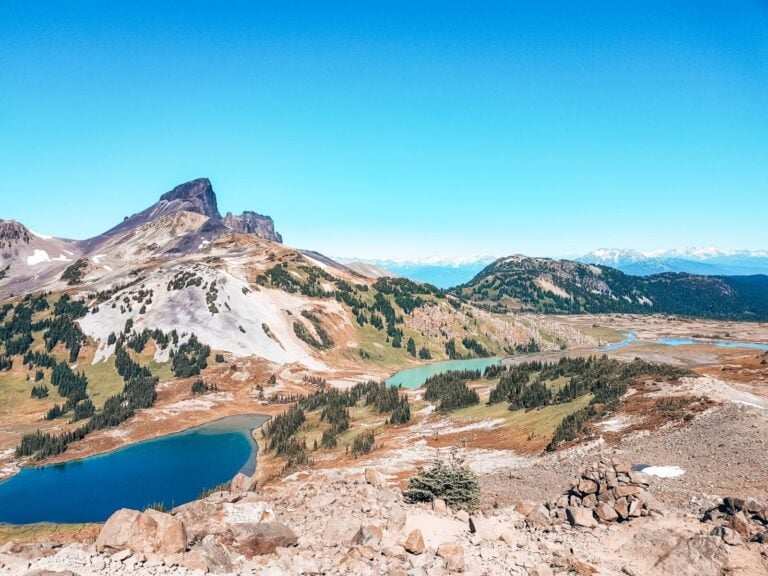
Expect turquoise glacial water, a huge jagged black rock formation that looks like it belongs on another planet, and alpine meadows full of wildflowers, with snow still clinging to the peaks even in August. It’s one of the best hiking spots in British Columbia, and if you’re only doing 1 trip to Garibaldi Provincial Park, this is the combination to do.
Here’s exactly how we hiked it, what to expect at each stage and everything else you need to know before you go.

Hiking to Garibaldi Lake, Black Tusk and Panorama Ridge in 1 day is doable, but it’s extremely challenging. Some hikers manage it in around 12-14 hours. My brother and I completed the Panorama Ridge hike in 1 day in around 9 hours, and that was tiring enough.
Splitting it over 2 days, camping at Garibaldi Lake Campground in between, is what Andy and I did, and what we’d recommend.
On day 1, you’ll hike to Garibaldi Lake, drop off your camping gear, continue up to Black Tusk, then return to the campsite. On day 2, you’ll hike to Panorama Ridge, then return via the campsite to grab your stuff. Tackling Panorama Ridge the next day with fresh legs makes such a difference. Also, spending the night on the shore of Garibaldi Lake is an incredible experience in itself (more on that later).

Garibaldi Provincial Park, or Garibaldi Park as it’s often called, sits in the heart of the Coast Mountains, about 64km north of Vancouver and just south of Whistler. It spans 1,950 square kilometres and is named after Mount Garibaldi, the stratovolcano at its centre, standing at 2,678 metres.
The park has 2 main access points: Rubble Creek and Diamond Head, both just off the Sea to Sky Highway. Rubble Creek is the one you’ll want for Garibaldi Lake, Black Tusk and Panorama Ridge. It’s also the starting point for Wedgemount Lake, another popular hike in the park.
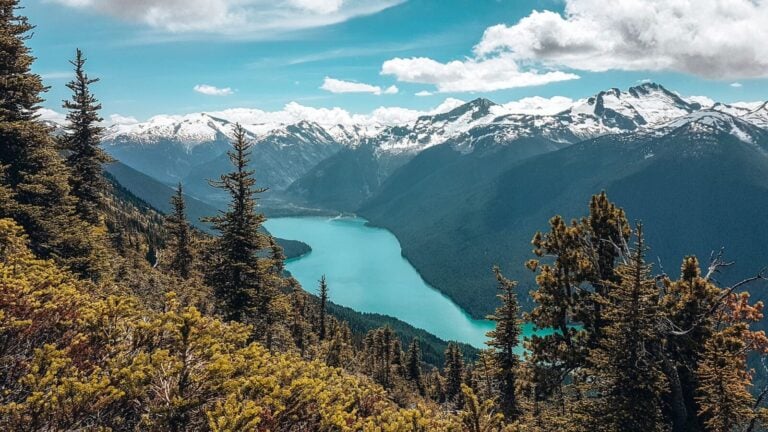
Cheakamus Lake is accessible from a different trailhead nearby too. We’ve seen it from above on the High Note Trail on Whistler Mountain, and it looks amazing from up there. If you’d rather see it properly, there’s a guided hike that takes you right to the shore.
Trails are well signposted, so you shouldn’t need a map (we didn’t have 1). If you’d rather have one, BC Parks has a basic version, or the Clark Geomatics Garibaldi Park map on the Avenza Maps app is really detailed and works offline if you’re out of signal (which you will be).

Rubble Creek Car Park has 200 spaces, with overflow parking available along Daisy Lake Road once that fills up, which it regularly does in the summer. The number of day-use passes released each day matches the car park’s capacity.
Hiking isn’t the only way to see this park. Helicopter tours give you a totally different view of the peaks and glaciers from above, glacier landings let you actually stand on one, and via ferrata routes are worth it if you fancy some real exposure without needing full climbing gear.
Rubble Creek has no accommodation, so you’ll want to base yourself in Squamish or Whistler the night before.
Squamish is closer, about a 20-minute drive to the trailhead, ideal if you’re planning an early start. The Executive Suites Hotel and Resort is a great option, close to town with an indoor and outdoor pool.
Whistler’s further, closer to 40 minutes, but if you’re combining this hike with other things to do in Whistler, it’s worth the extra drive. And there are so many more options for eating and drinking out. Personally, we’d choose Whistler over Squamish.
The Listel Hotel is a fantastic base (I used to work there too). It’s just off Whistler Village, so it’s quiet in the evenings but less than a minute’s walk away.
Your first stop is Garibaldi Lake Campground to set up camp and have lunch before heading on to Black Tusk. It’s 9km from Rubble Creek Car Park, so it’s also a great day hike from Whistler if you just have a day.
The first 6km is fairly tedious, constant switchbacks through dense forest with not much to look at, though it’s shaded from the sun at least. After 6km you’ll reach a junction. Turn left if you’re hiking to Black Tusk or Panorama Ridge in a day. Garibaldi Lake is to the right, and from here the trail becomes much more scenic.
The next 3km becomes more rugged, with some clambering over tree roots and branches. Shortly after the junction, you’ll pass The Barrier, a sheer lava dam formed during a landslide in 1885. If it were ever to collapse, the resulting wave would cause severe flooding in the Cheakamus and Squamish valleys.

You’ll then pass Lesser Garibaldi Lake, a preview of what’s still to come.

A few more switchbacks and a steep dirt slope lead down to a wooden bridge.

Cross it, follow the path around, and the trees eventually open up to reveal Garibaldi Lake’s azure water, with Sphinx Glacier as the backdrop. It’s one of the most striking views in British Columbia.

Find a spot, pitch your tent, and have lunch.
Our Top Tip: Garibaldi Lake Campground books up weeks in advance, so reserve your spot early!

Once you’re set up, it’s time to head to Black Tusk.
Cross back over the bridge and up the dirt path. At the junction, go right. After more switchbacks, you’ll reach an open meadow with Black Tusk looming ahead, a jagged black rock that looks like it landed from another planet. It’s actually an extinct volcano, over a million years old, though don’t worry, there’s no risk of it doing anything more dramatic than looking rather intimidating.


In summer, the meadow is full of colourful alpine wildflowers.
Continue until you reach a junction and turn right. You’ll cross a few streams here, so if you need water, this is a great place to fill up.
Shortly after, you’ll reach Black Tusk Junction; turn left. The meadow’s been nice and flat so far; this is where the real challenge begins.

The climb starts well-worn and steep, but manageable. You’ll hit a signpost at the Black Tusk Viewpoint marking the “end of the maintained trail”. You can stop here if you’d rather not scramble further, or you can continue to the base of Black Tusk.
Our Top Tip: the official advice is not to hike any further due to severe rockfall hazards and unstable volcanic rock. So, before you decide you’re going to continue, do your own research and make sure you’re comfortable.
If you continue, the remaining trail is loose, exposed volcanic scree, the result of tens of thousands of years of erosion. Even in August, you’ll likely find snow up here, as we did. It’s quite nice to lie in and cool down.

You’ll feel like you’re taking three steps up and two back; it’s a genuine slog. But the views of Garibaldi Lake below make every break worth it.

Once you reach the base of Black Tusk, you can pick out Whistler Mountain in the distance. After all the times we’d looked over at this rock from the top of Whistler, actually being here felt surreal.

Making your way down is much quicker and far more fun than the way up, as you can slide down the scree.
Once you’re back at camp, jump in the lake before the sun goes down. It’s glacial, so it’s freezing, but honestly so refreshing when you’re sweaty and covered in scree. It’s also your only way of washing.
Watch the sunset light up Sphinx Glacier before turning in for an early night. You’ll want it before Panorama Ridge tomorrow.
That evening is one of the moments from this trip that we still think and talk about. No signal, no noise beyond the odd tent a few pitches over. Just us, the lake, and Sphinx Glacier turning gold as the sun dropped behind the mountains.
It’s rare to switch off like that, fully, completely cut off from everything. And being surrounded by that kind of scenery with nothing else around made us feel really small. Like we were a tiny part of something so much bigger. This was also right at the start of our relationship, so we spent a few hours sitting by the lake getting to know each other. We love reminiscing about this.

Get up early. Panorama Ridge is one of Whistler’s most popular day hikes, and it shows. By mid-morning, the summit can be crowded, with a queue for photos at the best viewpoint. Leaving camp before the day hikers arrive makes a huge difference. We had the whole ridge to ourselves for a while before anyone else showed up.
The Panorama Ridge trail starts back up the same steep dirt slope and wildflower meadows from yesterday’s Black Tusk hike.
At Black Tusk Junction, keep straight instead of turning left. Continue through the meadow past streams and more wildflowers, with Black Tusk Lake and Mimulus Lake visible to your right.

Enjoy this bit of the hike; it’s flat. A welcome break before the final push.
At Panorama Ridge Junction, Helm Lake sits to your left; keep right instead, past Black Tusk Lake, before the ascent through alpine terrain begins.

The final climb involves scrambling over rock, which is steep and demanding, but the view from the top makes it so worthwhile.
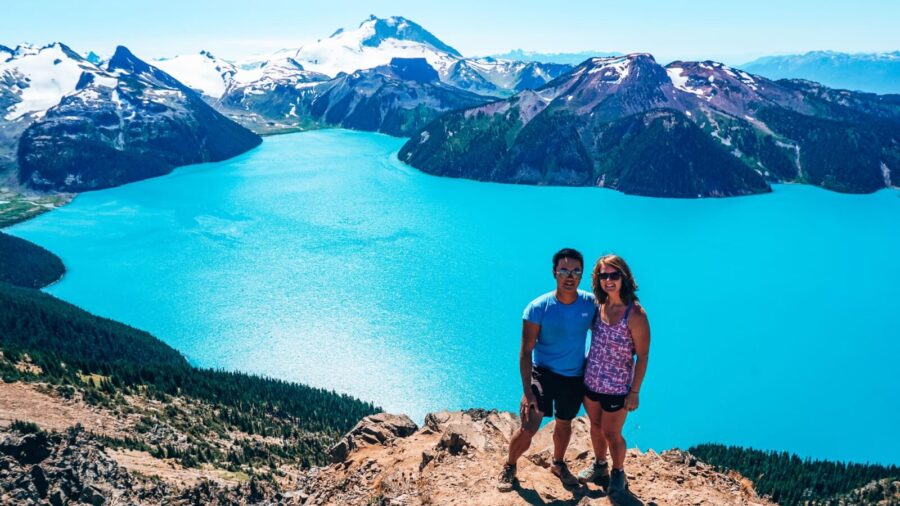
You’ll reach Panorama Ridge and get a full 360-degree view: Black Tusk and Helm Lake behind you, Sphinx Glacier beside you, and Garibaldi Lake’s turquoise water directly below. It’s easy to see how the ridge earned its name.

Take your time here before descending back to camp the way you came. Pack up your gear, take one last look at Garibaldi Lake, and head out.
The toughest section of the entire trip was the final 6km of switchbacks to the car park. They’re honestly relentless.
Garibaldi Lake Campground has 50 tent platforms and 4 cooking shelters, and it’s one of the best spots to camp in Garibaldi Provincial Park.
You must cook in the shelters; it’s a bear safety requirement. Food and anything scented needs to be hung on the bear poles provided rather than left in your tent. Bring your own stove too; they no longer supply them. You’ll also need to bring your own toilet paper for the outhouses.
Remember to take everything you brought with you back out again; there are no bins.
Taylor Meadows is the other camping option in this part of the park, closer to the junction than Garibaldi Lake. We chose Garibaldi Lake for the lake access. Being able to swim and watch the sunset right from camp made it worth the extra distance. We’d recommend doing the same. Being on the shore is honestly spectacular.
If you’re tighter on time, then Taylor Meadows is a good alternative, though be aware it can close seasonally when bears are active in the berries nearby.

All distances and elevation gains below are round trip, from Rubble Creek Car Park.
Since our itinerary has you camping at Garibaldi Lake and hiking Black Tusk and Panorama Ridge from there, the distances and elevations from the campground are:
Yes, some hikers do, but it’s genuinely really challenging. Also, you won’t have much time to actually enjoy the views and appreciate where you are. Splitting it over two days, as we did, is easier on your legs and lets you enjoy both rather than rushing.
If you only have time for a day hike, then we’d recommend prioritising 1 rather than trying to do them both. I hiked Panorama Ridge with my brother a few weeks before this trip, and that took us around 9 hours.
Panorama Ridge is my pick. The view over Garibaldi Lake, that deep blue water surrounded by snow-capped mountains, is unlike any view I’ve ever experienced. Still one of my favourite views ever, I don’t think I’ll ever get over it.
Black Tusk is still an incredible hike, with its own great views over the surrounding mountains and Garibaldi Lake below. But being closer to the lake, and seeing the whole thing rather than a partial view, is what tips it for me towards Panorama Ridge.
If you only have time for 1, make it Panorama Ridge.
The trailhead is located at Rubble Creek Car Park, just off the Sea to Sky Highway.
From Whistler, drive south for 25km until you see a sign for Garibaldi Provincial Park on your left, down Daisy Lake Road. Follow this for 3km.
From Vancouver, drive north on the Sea to Sky Highway through Squamish, continue 33km past Squamish, and Daisy Lake Road will be on your right.
If you’re not driving your own car, renting one is the easiest way to do this trip, especially if you’re also staying in Squamish or Whistler the night before.
There’s no public transport to Rubble Creek. Without a car, you can either take a taxi the whole way or the number 20 bus to Bayly Park, then a taxi for the remaining distance. Alternatively, book a guided day hike to Garibaldi Lake and Panorama Ridge with pick-up from Vancouver, or if you’d rather just tackle Panorama Ridge on its own, there’s a guided single-day version of that too.
Sorted your hotel yet? Find somewhere to stay in Squamish or Whistler if not.
You can hike in Garibaldi Provincial Park year-round, but winter requires proper equipment.
For summer hiking, Garibaldi Lake is usually accessible from early June, while Panorama Ridge and Black Tusk are best from late July/early August when the snow has reduced (it never fully disappears).
You’ll need a reservation for any overnight stays, year-round, and campsites book up weeks in advance in summer; some sell out within minutes of the booking window opening.
Camping fees are currently $25 per person, per night, plus a $6 non-refundable booking fee. If you’re travelling from outside BC, there’s also a $20 non-resident surcharge on top.
Day hikes between June and October need a free day-use pass, which is automatically included in your backcountry reservation if staying overnight.
You can book campsite reservations and day-use passes online here, and reservations open 90 days ahead of your arrival date, from 7am Pacific Time. Popular dates sell out within minutes, so it’s worth getting on it at 7am.
Yes, black bears are common throughout the park, especially as berries ripen later in summer. Grizzlies, cougars and wolverines are also present but rarely seen. If you’re camping, use the cooking shelters and bear poles provided, never store food or anything scented in your tent, and make noise while hiking to avoid surprising one.
If you do encounter a bear, stay calm, speak in a firm voice so it identifies you as human, and back away slowly rather than running.
Yes, there are a few streams along the way to refill, and at Garibaldi Lake Campground you can draw water straight from the lake.
Cell service is very limited or non-existent. If you’d like a map, download an offline Garibaldi Provincial Park map and make sure you let someone know your plans before you set off.
No, dogs aren’t permitted in Garibaldi Provincial Park.
We hope this helps you plan your own trip to hike Garibaldi Lake, Black Tusk and Panorama Ridge. If you’ve got any questions, drop us a comment below, and check out our other Canada guides while you’re here.
And come find us on Instagram for real-time updates, behind-the-scenes chaos and more travel tips and inspiration 😊